Thursday, June 28, 2012
Happy Semester Fun Time
So... we did a lot this past semester. We studied the differences between accuracy and precision in unit one, in unit two we tried to find a way to answer the question "are you moving?" We studied motion motion as it moved in more than one dimension and learned how to measure said motion using vectors in unit three. And, in unit four, we revisited every thing we knew back in unit two and screwing with it until I could barely recognize it. (Math never was my strong suit.) In unit five, we studied Newton's Laws and I found out on my own that playing the "a motion that is in rest stays in rest" card does not put me in good standings with my mom and makes me even less likely to get out of chores.

Unit 5: Equillibrium
So... basically we did the same thing we did the day before, but on a more confusing level. We applied the three laws that we had learned the day before and, using the four newly learned forces, solved problems and shit.
Can you tell I didn't really understand?
Anyway, the four forces we talked about were weight (the force that pulls you straight down), normal (the force that makes sure you don't fall down into the center of the earth or something like that), tension (... something about being pulled by strings...), and friction (the thing that gives you a rug burn when you slide on carpets or skin your knee on a sidewalk when your friend doesn't realize you have terrible balance and thinks it would be fun to play life-saver.)
We drew free-body diagrams too... I know they're important, but at the moment, my head is killing me and I can't really describe it...
We drew free-body diagrams too... I know they're important, but at the moment, my head is killing me and I can't really describe it...

Unit 5: Newton's Laws
For the first day of unit 5, we talked about someone named Newton and some stuff he said a long time ago. We learned about three different laws in particular.
Newton's 1st Law- An object that is in motion/rest will stay in motion/rest unless acted upon by an unbalanced force.
(I tried telling my mom I couldn't help her with the dishes because it went against Newton's laws but she just took my laptop away.)
Newton's 2nd Law- Force = mass x acceleration
Newton's 2nd Law- Force = mass x acceleration
(Mass and acceleration are inversely related to each other. I got that wrong on the remote quiz-things. A lot.)
Newton's 3rd Law- Between two interacting objects, there are equal and opposite forces between them.
Newton's 3rd Law- Between two interacting objects, there are equal and opposite forces between them.
(Like when you push one of your annoying friends in front of a bus. They hit the bus just as hard as the bus hits them, though one gets off with only a messed up paint job and the other is broken. Which is which, you decide.)
^Newton
Unit 4: 2D Kinematics (continued)
For this part of the unit, we launched rockets.
Using the equation d=1/2at^2 +Vot, we attempted to calculate the distance our rocket would go in order hit our teacher with rockets. We were given three different caps, labeled low, medium and high respectively, and were let free to do basically whatever we wanted. Following the sole rule of not injuring anyone.
Rules ruin all the fun.
Anyways, after calculating the velocity of each of the caps, we decided to go with the medium cap because it had the most reliable results.
Sadly, we missed every time. (I'm just kidding. Oh my god please don't fail me.)

If you don't understand, we can't be friends.
Thursday, June 21, 2012
Unit 4: 2D Kinematics
Ok, so if I were to be totally honest, I didn't understand this unit at all. But here's the way I kind of see it.
2D kinematics is almost identical to regular kinematics, except for that it's possible to go in more than one direction. Like if you throw a ball up to your right. It doesn't go straight up and come back down, nor does it travel to your right in a horizontal line, never slowing down (unless it runs into an unbalanced opposing force!! I remember that part!). No. It flies up in the air, moving to the right.
The way to measure this is fairly simple; you just need to remember the "Vegas rule." Ever heard of the term "what happens in Vegas stays in Vegas?" What happens on the x-axis stays on the x-axis and vice-versa.
We also covered something about SOHCAHTOA, which I completely forgot about as soon as I finished my Geom final exam last year (that's untrue... I forgot it before I started it), but for the life of me I can't remember...
 This is why I didn't ask to take math over the summer.
2D kinematics is almost identical to regular kinematics, except for that it's possible to go in more than one direction. Like if you throw a ball up to your right. It doesn't go straight up and come back down, nor does it travel to your right in a horizontal line, never slowing down (unless it runs into an unbalanced opposing force!! I remember that part!). No. It flies up in the air, moving to the right.
The way to measure this is fairly simple; you just need to remember the "Vegas rule." Ever heard of the term "what happens in Vegas stays in Vegas?" What happens on the x-axis stays on the x-axis and vice-versa.
We also covered something about SOHCAHTOA, which I completely forgot about as soon as I finished my Geom final exam last year (that's untrue... I forgot it before I started it), but for the life of me I can't remember...

This past quarter... (... oops)
We learned about many things this first quarter in physics.
We studied were scientific notation, the metric system and dimensional analysis. Scientific notation is an easier way to represent extremely large or extremely small numbers in terms of decimal numbers between 1 and 10 multiplied by a power of ten. 0.0000000348 can also be written as 3.48 x 10^-8.
We also studied the differences between scalar and vector quantities. Scalar is a quantity that has magnitude while a vector is a value that has both magnitude and direction (oh yeah!). An example of this would be, if a scalar quantity is 10 steps, a vector quantity would be 10 steps north. Scalar is measured in distance (meters) and vector is measured in displacement (also in meters). Distance in physics can simply be defined as how far. Displacement is defined as distance with direction.
We studied were scientific notation, the metric system and dimensional analysis. Scientific notation is an easier way to represent extremely large or extremely small numbers in terms of decimal numbers between 1 and 10 multiplied by a power of ten. 0.0000000348 can also be written as 3.48 x 10^-8.
We also studied the differences between scalar and vector quantities. Scalar is a quantity that has magnitude while a vector is a value that has both magnitude and direction (oh yeah!). An example of this would be, if a scalar quantity is 10 steps, a vector quantity would be 10 steps north. Scalar is measured in distance (meters) and vector is measured in displacement (also in meters). Distance in physics can simply be defined as how far. Displacement is defined as distance with direction.
Tuesday, June 19, 2012
Unit 3: Acceleration (continued)
In unit 3, we focused on acceleration and the variables that also affect it like velocity, time and distance. According to a theory of Galileo's, discovered that freely falling bodies, heavy or light, have the same, constant acceleration and that this acceleration is due to gravity. We spent today trying to discover that on our own through our own experiments.
An example we were shown in class was that if a tennis ball and a volleyball were dropped at the same height at the same time (in an air-less environment), even though the mass of each ball was different, they would land at the same time. This is because the pull of gravity is always constant. Heavier things don't fall faster then lighter things (in an air-less environment, as air resistance is the reason paper is an exception on Earth)
---will post picture tomorrow--
Monday, June 18, 2012
Unit 3: Acceleration
In unit 3, our aim was to study motion motion as it moves in more than one dimension and learn how to measure said motion using vectors. To start our studies, we went outside with a skateboard (or whatever we called it... the danger board?) and set in on top of a hill. We measured the time it took for the person on the board to pass each of the timers that were spread out over 50 meters at 5 meter intervals. Because acceleration happens, the more time that went on, the more distance the boarder covered.

A picture of the graph with the data from the experiment because I'm lame and never bring my phone with me when we do things I can take real pictures of for this.

A picture of the graph with the data from the experiment because I'm lame and never bring my phone with me when we do things I can take real pictures of for this.
Sunday, June 17, 2012
Unit 2 (Continued): Moa Kinematics
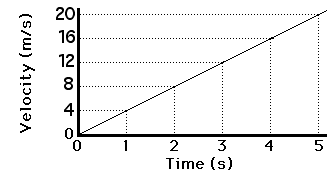
During the second part of unit 2, we expanded on the idea of kinematics. We analyzed graphs and tried to replicate them using a motion sensor. We found out the differences between a velocity vs time graph and a distance vs time graph and how to read and pick out the information we needed to know from a vt graph, like distance and slope, even though the way it looked and the way we found it were so different. Instead of drawing a diagonal line to represent slope like we did before, a straight line is drawn at the slope number itself (if it is constant) and moves either down or up accordingly if changed.
Thursday, June 14, 2012
Unit 2: Kinematics
During unit 2 of physics, we studied kinematics, or the study of motion. The question we were asked at the start of the unit was "are you moving?" The only way to answer the question was with another one: "relative to what?" All motion is relative. A car could be traveling 30 mph in one direction (relative to the ground) and another car could be traveling the same speed in the opposite direction, but relative to each other it appears to one as if the other is traveling at 60 mph while they stayed still.
It's all a matter of perspective.
We learned the between scalar and vector quantities. Scalar is a quantity that has magnitude while a vector is a value that has both magnitude and direction (oh yeah!). An example of this would be, if a scalar quantity is 10 steps, a vector quantity would be 10 steps north. Scalar is measured in distance (meters) and vector is measured in displacement (also in meters). Distance in physics can simply be defined as how far. Displacement is defined as distance with direction.
The lab we did in class was called the Physics Olympics. Timed, people would run, hop, and balance binders across a span of 50 meters. Since I hid at the 50 meter line and didn't actually participate in anything, here's a picture of a stopwatch because it's relevant.

http://preprofessionalmusings.files.wordpress.com/2010/08/ist2_6685580-stop-watch.jpg
It's all a matter of perspective.
We learned the between scalar and vector quantities. Scalar is a quantity that has magnitude while a vector is a value that has both magnitude and direction (oh yeah!). An example of this would be, if a scalar quantity is 10 steps, a vector quantity would be 10 steps north. Scalar is measured in distance (meters) and vector is measured in displacement (also in meters). Distance in physics can simply be defined as how far. Displacement is defined as distance with direction.
The lab we did in class was called the Physics Olympics. Timed, people would run, hop, and balance binders across a span of 50 meters. Since I hid at the 50 meter line and didn't actually participate in anything, here's a picture of a stopwatch because it's relevant.

Wednesday, June 13, 2012
Unit 1: Intro to Physics
Other things we studied were scientific notation, the metric system and dimensional analysis. Scientific notation is an easier way to represent extremely large or extremely small numbers in terms of decimal numbers between 1 and 10 multiplied by a power of ten. 0.0000000348 can also be written as 3.48 x 10^-8.
The lab we did in class revolved around pendulums. Through that, I learned that both mass and angle of release (of the pendulum) had nothing to do with period length contrary to what I previously thought.

The picture I chose to use was one that Mr. Blake took during the lab of my lab group. I decided to use this because it was easily accessible (thank you class website) and since there's no real chance of getting sued for using this picture on my blog I don't really have to go out and site the source (though I kind of already did).
Tuesday, June 12, 2012
Nobody Read This Post So I Could Edit It If I Wanted To
My name is Breana. I am 15 years old and live in Mililani, Hawaii. I have been attending Punahou since 6th grade. I took the required science classes all the way up through freshman year before deciding to take Biology and Geology of Hawaii instead of Chemistry sophomore year. Last year I took Geometry but in week or so between the end of final exams and the start of summer school I've somehow forgotten virtually everything that I had learned this past year.
By completing this course, I hope to gain a science credit (i.e. not failing) so I can clear more room in my junior year schedule to take more courses that interest me that I wouldn't have been able to done with a full year of Physics.
My picture:

I chose this picture because I've seen The Avengers twice in the past month or so and I still have to work on the Dimensional Analysis worksheet and figure out the review packet so I chose a random thing off my desktop.
Plus Chris Hemsworth looks like a Disney princess with that tiara.

By completing this course, I hope to gain a science credit (i.e. not failing) so I can clear more room in my junior year schedule to take more courses that interest me that I wouldn't have been able to done with a full year of Physics.
My picture:

I chose this picture because I've seen The Avengers twice in the past month or so and I still have to work on the Dimensional Analysis worksheet and figure out the review packet so I chose a random thing off my desktop.
Plus Chris Hemsworth looks like a Disney princess with that tiara.

Subscribe to:
Posts (Atom)